

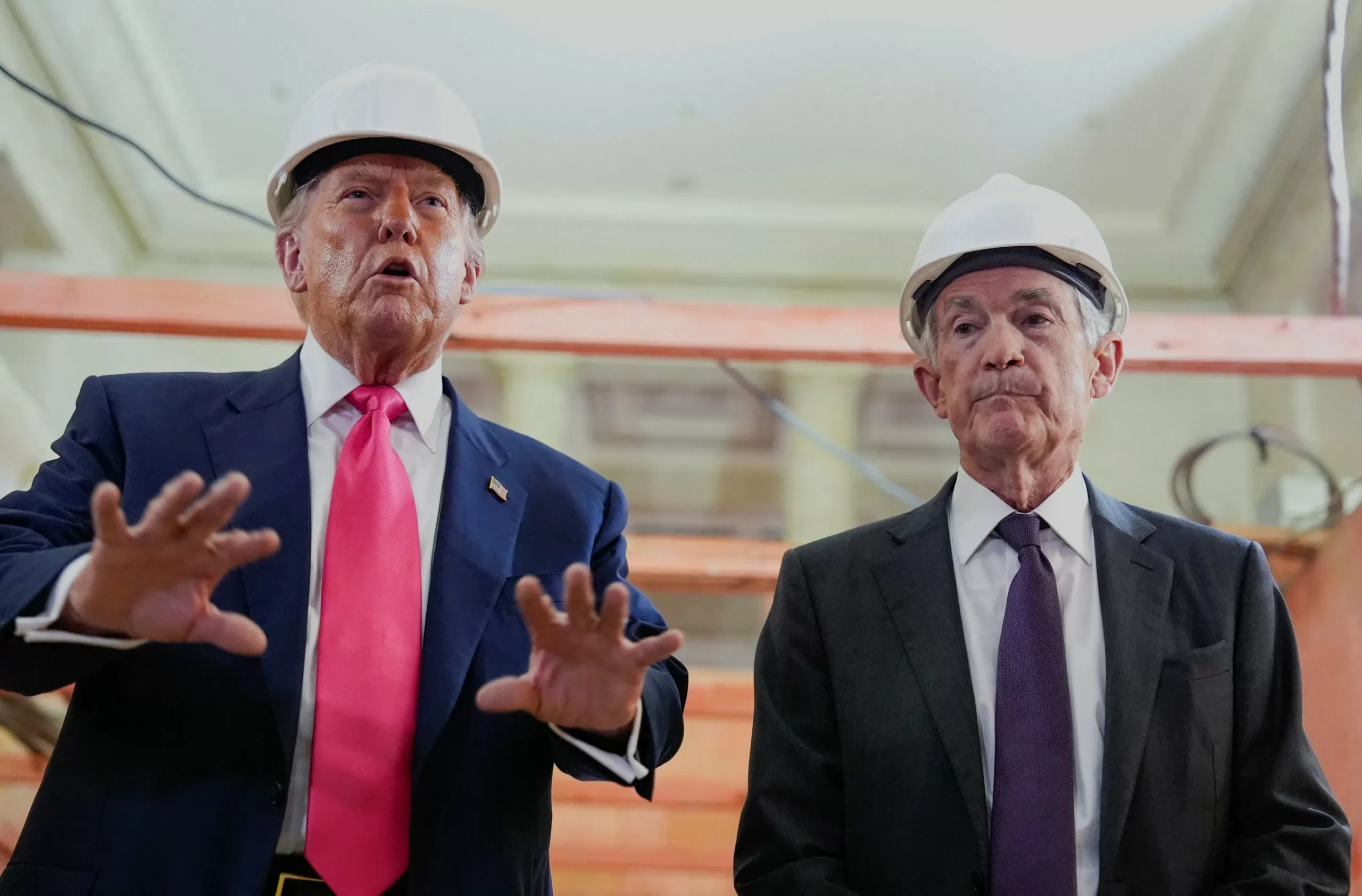

U.S. President Donald Trump has once again stirred up controversy with his views on the Federal Reserve’s current monetary policy. In a recent statement, he expressed his frustration with the Fed’s chairman Jerome Powell for not lowering interest rates, going as far as suggesting that the board should “assume control” if Powell continues to disagree.
Trump’s criticism of the Fed’s decision to not lower interest rates comes amidst concerns of a slowing economy. The president has been calling for rate cuts for quite some time now, believing it to be a vital step towards boosting economic growth and increasing consumer spending. However, this is not the first time he has publicly opposed the Fed’s policies, causing many to question the boundaries of the president’s involvement in monetary policy.
The Federal Reserve, which is an independent government agency, is responsible for setting monetary policy in the United States. This includes regulating interest rates, controlling inflation, and managing the country’s money supply. Its decisions are made by a board of governors, including the Fed chair, who are appointed by the president and confirmed by the Senate. According to the Federal Reserve Act, the board is designed to function independently from political pressure.
So, when President Trump openly criticizes the Fed for not lowering interest rates, it raises concerns about political interference and the independence of the Federal Reserve. Such comments from a head of state can also have a significant impact on the market, raising uncertainties among investors.
However, President Trump remains undeterred in his stance, stating that the Fed should “lower rates bigger and faster, and stop their ridiculous quantitative tightening.” He also added that the U.S. economy would be even stronger if the Fed had done its job properly, indicating that he sees the central bank as responsible for the current state of the economy.
While the Fed has remained steadfast in its decision to keep interest rates unchanged, it has not ignored the current economic conditions. In a statement released after its recent policy meeting, the Federal Open Market Committee (FOMC) acknowledged the weakening global economic growth, along with trade tensions and muted inflation, as factors that could potentially influence its future decisions.
Despite this, Powell has emphasized that the Fed’s decisions are based on data and economic indicators, and not influenced by political pressure. This statement was further reiterated by the Federal Reserve Bank of New York President, John Williams, who stated that the Fed would continue to make decisions based on what is best for the economy, regardless of political pressures.
In light of these recent events, it is important to recognize the significance of the Fed’s independence and its crucial role in maintaining the stability of the U.S. economy. The Fed’s goal is to achieve full employment and stable prices, and it must make decisions accordingly, without being swayed by political agendas.
President Trump’s comments have sparked a debate about the extent of political influence on the Federal Reserve’s decision-making process. While it is natural for a nation’s leader to have opinions and views on economic policies, it is vital that the independence of the Fed is respected, and its decisions are not influenced by external factors.
In conclusion, the Federal Reserve plays a crucial role in shaping the U.S. economy, and its decisions should be based on neutral and unbiased analysis. It is important for the Fed to continue its mandate of achieving low unemployment and stable prices without being subject to political pressures. As citizens, we must trust in the integrity of the Federal Reserve and support its independence to ensure the long-term stability and success of the American economy.