

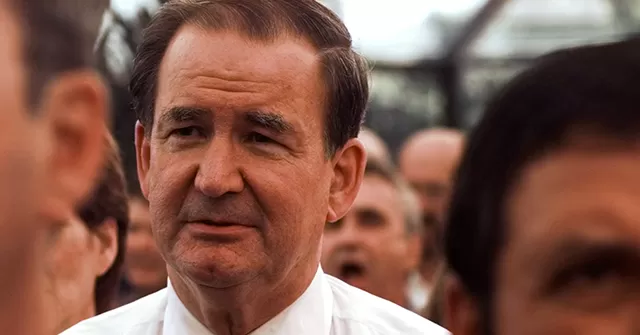

In a time of rapid globalization and international trade, there has been no shortage of debate and controversy over the benefits and consequences of such policies. While some argue that globalization has brought economic growth and prosperity, others have sounded the alarm about its potential negative effects on domestic industries and workers. One such voice that has consistently warned against the pitfalls of unchecked globalization is Pat Buchanan, a conservative commentator and former presidential candidate. In a new working paper, researchers from the National Bureau of Economic Research explore the hypothetical scenario of what would have happened if the United States had adopted Buchanan’s trade policies earlier. The findings are thought-provoking and raise important questions about the impact of trade policies on our economy and society.
The paper, titled “What if We Had Listened to Pat Buchanan? Lessons from a Counterfactual Analysis of Trade Policies,” takes a closer look at Buchanan’s proposed protectionist policies and their potential impact on the US economy. Buchanan has long argued that free trade agreements and global integration have had detrimental effects on American industries and workers. He has advocated for policies such as imposing tariffs on imports and renegotiating trade deals to prioritize domestic industries. The paper examines what would have happened if the US had followed Buchanan’s advice and adopted these policies as early as the 1980s.
The results of the counterfactual analysis are eye-opening. The researchers found that if the US had implemented Buchanan’s policies, the country’s GDP would have been 3.5% higher in 2016, equivalent to an additional $800 billion. This finding challenges the widely held belief that free trade and globalization are unequivocally beneficial for economic growth. It also highlights the potential consequences of ignoring the warnings of those who have long been critical of unfettered trade.
But the paper does not stop at economic impacts. It also examines the effects on employment and wages. The results show that if the US had listened to Buchanan, there would have been 4.7 million more jobs in 2016 and wages would have been 2.3% higher. This suggests that Buchanan’s protectionist policies could have potentially benefited American workers and helped mitigate some of the negative effects of globalization.
The paper’s findings are significant, not only because they challenge conventional wisdom but also because they raise important questions about the trade policies we have adopted and their impacts on our economy. It begs the question: have we sacrificed the wellbeing of our industries and workers in pursuit of global economic integration? And could we have avoided some of the negative effects of globalization by heeding the warnings of people like Buchanan?
It’s worth noting that the counterfactual analysis assumes that the US would have implemented Buchanan’s policies perfectly, without any flaws or unintended consequences. This, of course, is not realistic, as no policy is without its challenges and drawbacks. But the paper’s findings still provide valuable insights and serve as a reminder that we need to carefully consider the impact of trade policies on all sectors of our economy, not just the big businesses and corporations.
It’s also important to acknowledge that there are strong arguments for and against free trade and globalization, and this paper does not attempt to settle that debate. Instead, it presents a hypothetical scenario that invites us to reflect on the consequences of our choices and the potential benefits of alternative policies.
In conclusion, the National Bureau of Economic Research’s working paper offers a thought-provoking look at what could have been if the US had followed Pat Buchanan’s advice on trade policies. It suggests that there could have been significant economic benefits for the country, including higher GDP, more jobs, and higher wages. While it’s impossible to turn back time and change our trade policies, this analysis serves as a reminder that we should carefully consider and evaluate the potential implications of such policies before implementing them. Only then can we ensure that our economy and workforce are protected and thriving in an ever-changing global landscape.