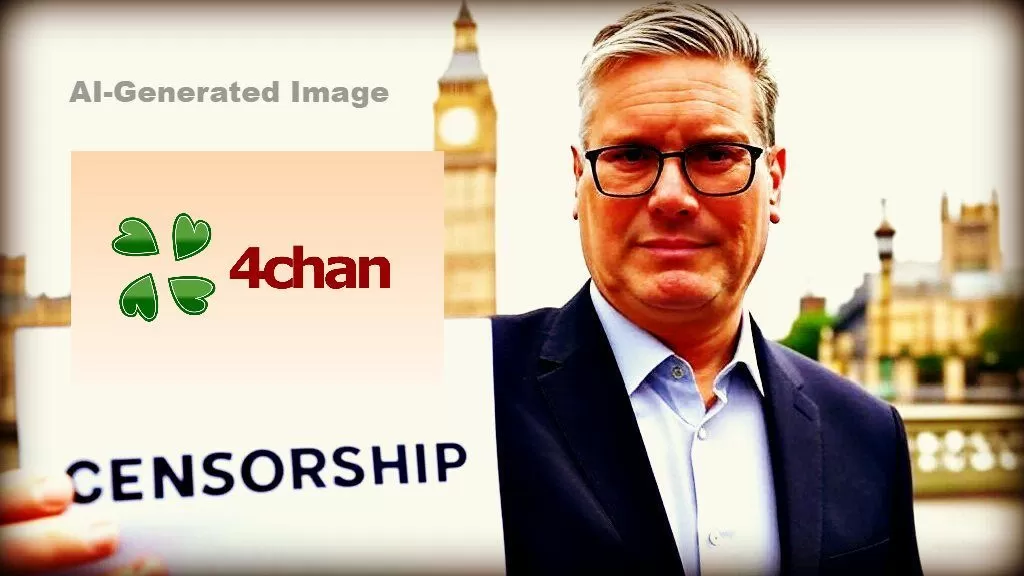

Censorship-mad UK is once again making headlines as it targets US tech companies in its latest attempt to control online content. The country’s media regulator, Ofcom, has recently imposed fines on popular online forum 4chan for allegedly violating the UK’s strict censorship laws. However, the platform has refused to pay the fines, stating that it has broken no laws in the United States.
This latest move by the UK government is just another example of its relentless pursuit to censor and control the internet. The proposed ‘Online Safety Act’ has been met with widespread criticism and resistance, with many arguing that it goes against the principles of free speech and expression. And 4chan’s refusal to comply with Ofcom’s fines is a clear indication that the fight against censorship is far from over.
For those unfamiliar with 4chan, it is an anonymous online forum where users can share and discuss a wide range of topics, from politics and current events to memes and internet culture. The platform has gained a reputation for its controversial and often offensive content, but it has also been a breeding ground for creativity and free expression.
The UK’s attempt to censor 4chan is not the first time the country has targeted US tech companies. In 2019, the UK government proposed the ‘Online Harms White Paper,’ which aimed to hold social media platforms accountable for harmful content posted by their users. This move was met with strong opposition from tech giants such as Facebook and Google, who argued that it would be impossible to monitor and regulate all user-generated content.
But the UK government seems determined to push through its censorship agenda, and 4chan is just the latest victim. Ofcom has accused the platform of failing to remove offensive and harmful content promptly, as required by UK law. However, 4chan has maintained that it operates under US laws, and therefore, Ofcom has no jurisdiction over its content.
This clash between the UK and US laws highlights the complexities of regulating the internet, especially when it comes to platforms that operate globally. It also raises questions about the extent to which governments should be able to control online content and the potential consequences of such actions.
One of the main concerns with the proposed ‘Online Safety Act’ is that it could lead to a slippery slope of censorship, where any content deemed offensive or harmful by the government could be removed without due process. This could have a chilling effect on free speech and expression, as individuals may fear repercussions for sharing their opinions or ideas online.
Moreover, the UK’s censorship efforts could have a significant impact on the global tech industry. Many US companies may be hesitant to operate in the UK if they are subject to strict censorship laws that go against their values and principles. This could stifle innovation and economic growth, as well as limit access to diverse perspectives and ideas.
In light of these concerns, it is crucial for individuals and organizations to continue to resist censorship and fight for the protection of free speech and expression. 4chan’s refusal to pay the fines imposed by Ofcom is a powerful statement against the UK’s censorship-mad policies. It shows that the fight for internet freedom is not just about protecting controversial platforms like 4chan, but about preserving the fundamental right to express oneself freely.
In conclusion, the UK’s pursuit of US tech companies in its quest for censorship is a cause for concern. It not only goes against the principles of free speech and expression but also has the potential to stifle innovation and limit access to diverse perspectives. 4chan’s defiance against Ofcom’s fines is a reminder that the fight against censorship is far from over, and it is up to us to continue to defend our right to express ourselves freely online.