

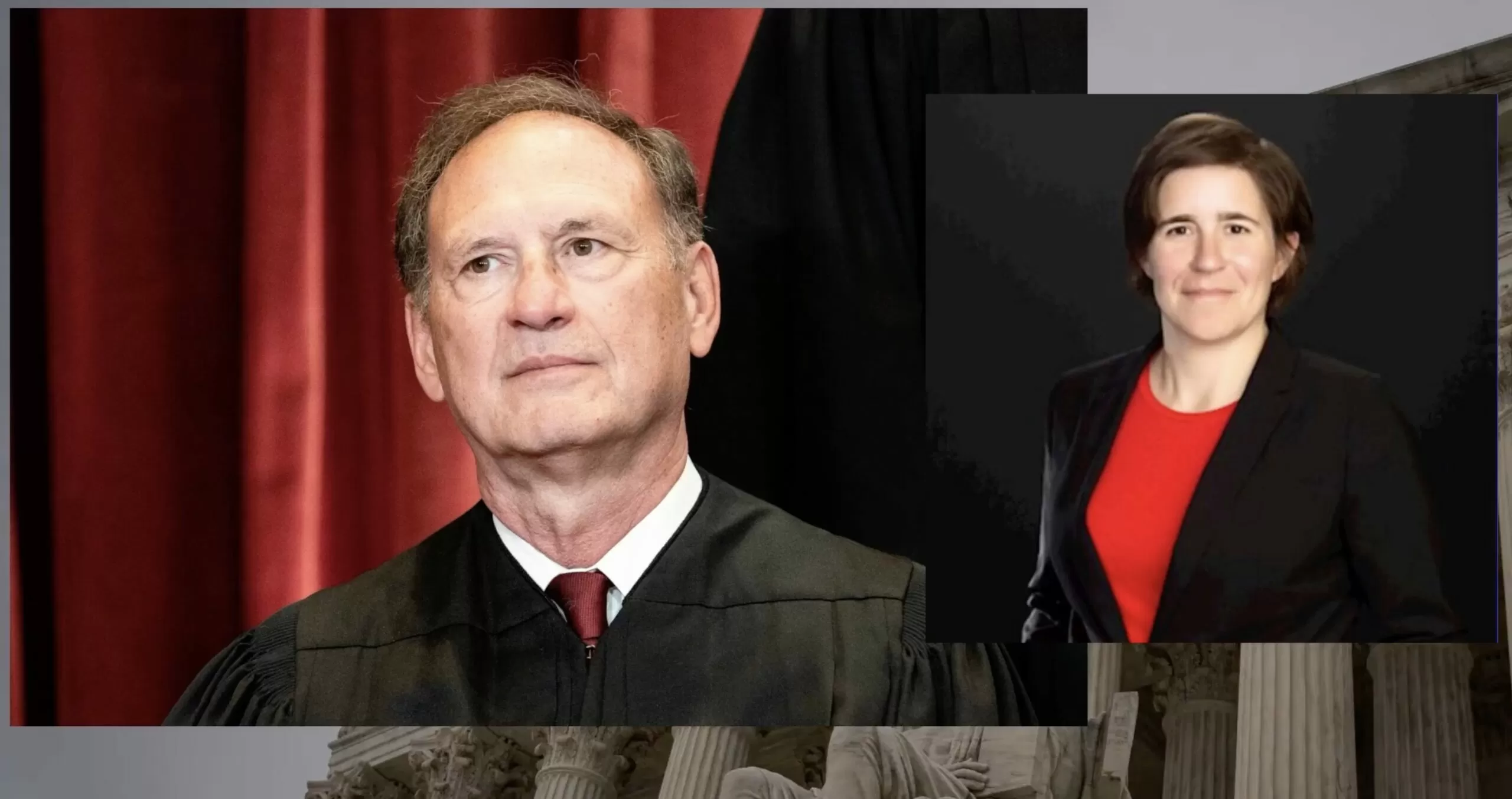

In a recent Supreme Court case regarding the participation of transgender athletes in women’s sports, Justice Samuel Alito posed a seemingly simple question to an ACLU lawyer: “Can you define what a man is? Or a woman?” What followed was a moment of hesitation and awkward silence from the lawyer, as she struggled to come up with a clear and concise answer.
This exchange, which has since gone viral, highlights the complexity and controversy surrounding the issue of transgender individuals in sports. On one side, there are those who argue that allowing transgender athletes to compete in sports that align with their gender identity is a matter of equality and inclusion. On the other side, there are concerns about fairness and the potential advantages that biological males may have in women’s sports.
But beyond the heated debate and legal arguments, Justice Alito’s question raises an important point: how do we define and understand concepts like “man” and “woman” in today’s society? This is a question that goes far beyond the realm of sports and has implications for our understanding of gender identity and the evolving nature of human beings.
In the past, the answer to this question may have seemed simple. Boys are boys, girls are girls, and there is no confusion or overlap. But as our understanding of gender has evolved, so too has our understanding of what it means to be male or female. Gender is no longer seen as a binary, fixed concept, but rather a spectrum with a variety of expressions and identities.
And while this may seem like a new and radical idea, it is not without historical and cultural precedent. Many indigenous societies, for example, have recognized and honored individuals who do not conform to traditional gender norms. In some cultures, these individuals are even seen as having special spiritual powers. It is only in recent times, with the rise of modern medicine and the influence of Western ideas, that our understanding of gender has become more rigid and restrictive.
So, when Justice Alito asked for a definition of a man or woman, he was unknowingly asking a question that is much more complex than it may seem. How do we define something that is constantly evolving and subjective? How do we define something that is deeply personal and can mean different things to different people? It is not a question that can be easily answered in a court of law, or even in a 900-word article.
But what we can do is recognize the humanity and dignity of all individuals, regardless of their gender identity. We can strive for a society that is truly inclusive and accepting of all people, regardless of their gender expression. And we can have respectful and open conversations about these complex issues, rather than resorting to polarizing and divisive rhetoric.
In the case of transgender individuals in sports, there are valid concerns about fairness and the potential advantages of biological males competing in women’s sports. However, these concerns should not overshadow the fact that transgender individuals are also deserving of equal rights and opportunities. It is not an either-or situation, and the solution may lie in finding a balance that takes into consideration the needs and rights of all individuals.
In conclusion, Justice Alito’s question may have stumped the ACLU lawyer, but it should also make us reflect on the larger issues at play. It should make us question our preconceived notions of gender and challenge us to have more nuanced and understanding conversations about these complex issues. It is only through empathy and open-mindedness that we can truly move towards a society where all individuals are accepted and celebrated for who they are.