

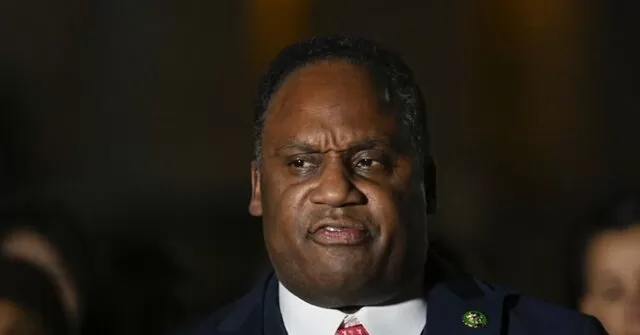

In a recent announcement, the State Department revealed that it will be reviewing the social media accounts of applicants for student visas. This decision has sparked a debate among lawmakers, with some expressing concerns about the subjectivity of the guidelines. One such lawmaker is Rep. Jonathan Jackson (D-IL), who appeared on MSNBC’s “Way Too Early” to share his thoughts on the matter.
During the broadcast, Rep. Jackson expressed his reservations about the State Department’s decision, stating that the guidelines are “too subjective.” He also added that the vetting process should be broader in order to ensure the safety and security of our nation.
While it is important to prioritize national security, Rep. Jackson makes a valid point about the potential subjectivity of the guidelines. It is crucial that the vetting process is fair and unbiased, and that individuals are not denied a student visa based on their personal beliefs or opinions expressed on social media.
Furthermore, Rep. Jackson’s call for a broader vetting process is also worth considering. In today’s digital age, social media has become a powerful tool for communication and self-expression. It is not uncommon for individuals to have multiple social media accounts, each serving a different purpose. Therefore, it is important that the State Department takes a comprehensive approach in reviewing an applicant’s social media presence.
However, it is also important to note that the State Department’s decision to review social media accounts is not without reason. In recent years, there have been instances where individuals with extremist views have entered the country on student visas. This poses a serious threat to our national security and cannot be ignored.
In light of this, it is understandable that the State Department is taking steps to ensure that individuals entering the country on student visas do not pose a threat to our nation. However, it is equally important that these measures are carried out in a fair and objective manner.
It is also worth mentioning that the State Department’s decision is not unprecedented. In fact, several other countries, including the United Kingdom and Australia, have already implemented similar measures. This further highlights the need for a comprehensive and standardized vetting process for student visa applicants.
In conclusion, while the State Department’s decision to review social media accounts of student visa applicants may have raised concerns about subjectivity, it is a necessary step in ensuring the safety and security of our nation. However, it is important that the guidelines are fair and unbiased, and that the vetting process is comprehensive. Let us hope that the State Department takes these factors into consideration and implements a fair and effective vetting process for student visa applicants.