

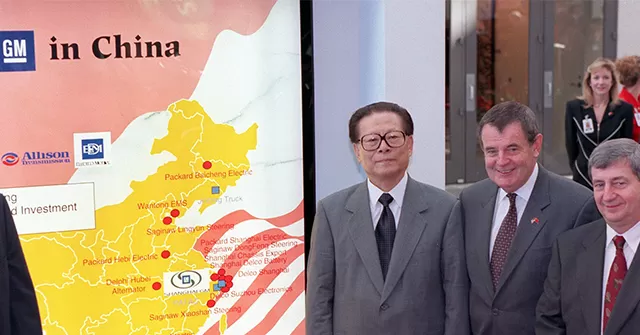

For decades, American companies have dominated the global market, thanks in large part to their technological advancements. However, in recent years, there has been a growing concern that the United States has been giving away its technology edge to China. This has resulted in a significant shift in the international landscape, as China has emerged as a major player in the global economy.
The main reason for this shift can be traced back to a straightforward calculation that American companies have been making for years. The logic was simple – by sharing their technology with Chinese partners, they could gain access to the world’s largest consumer market and take advantage of its low-cost labor. This seemed like a win-win situation, as American companies could expand their business and increase their profits while also benefiting from China’s cheap manufacturing capabilities.
As a result, numerous American companies have set up operations in China, forming partnerships with local firms and sharing their technological know-how. However, what many failed to realize at the time was that China had a different long-term vision – to become a dominant global player in not just manufacturing but also technology. And the United States was unknowingly helping them achieve this goal.
The rise of Chinese companies such as Huawei, ZTE, and Tencent, to name a few, is a testament to this. These companies, once seen as mere imitators, have now developed their own cutting-edge technology and are competing with American companies in various industries. This has caused a significant shift in the global balance of power, with China rapidly catching up to the United States in terms of technology and innovation.
Moreover, this sharing of technology has also inadvertently led to intellectual property theft and forced technology transfers. American companies have reported instances where their Chinese partners have stolen their technology or compelled them to transfer it in exchange for access to the Chinese market. This has not only resulted in the loss of billions of dollars in revenue for American companies but has also given China a competitive edge in the global market.
The consequences of this technology-sharing strategy are now becoming evident. China’s rise as a global technological leader has not only affected American companies but has also created a sense of insecurity and unease among other countries. Many are now worried about China’s intentions and its increasing control over vital technologies such as 5G, artificial intelligence, and advanced manufacturing.
However, it is not too late for the United States to take back its technology edge. In recent years, the US government has taken steps to address this issue, such as tightening regulations on foreign investment in critical industries and imposing tariffs on Chinese imports. American companies, too, are becoming more cautious and are looking at alternative markets and strategies to protect their technology.
But perhaps the most significant change that needs to happen is a shift in the mindset of American companies. Instead of solely focusing on short-term profits, they need to recognize the long-term consequences of sharing their technology with China. They must also understand that they are not just giving away their technology, but also their competitive advantage and the future of American innovation.
In conclusion, the United States must take a critical look at its technology-sharing strategy with China. While it may have seemed like a lucrative opportunity in the past, it is clear that the long-term consequences of this approach are detrimental to the country’s interests. As the global economy continues to evolve, the United States must protect its technology edge and maintain its position as a global leader in innovation. Only then can it truly compete with emerging technological powers such as China and secure its economic future.